In this interview by Nathalie Blanc, Maria-Thalia Carras, a curator deeply engaged with ecological issues, shares her experiences and reflections on artistic practices that intersect with science, diverse forms of knowledge, and territorial transformation. Drawing on concrete examples from projects in Aitoliko and Tavros, Greece, she highlights the complexities of collaboration between artists, scientists, and local communities, while exploring questions of legitimacy and the role of art in addressing ecological challenges.
Maria-Thalia emphasises the importance of an open and pluralistic approach to knowledge—one that moves beyond traditional hierarchies—and stresses art’s unique capacity to create spaces of dialogue where scientific knowledge, indigenous wisdom, and artistic practices intersect. She also illustrates the tangible impacts of these initiatives on local territories, where trust-building and exchange foster a newfound desire for knowledge, especially in areas where cultural offerings are scarce and often concentrated in major cities.
Nathalie Blanc: Thank you for accepting this interview. To begin with, could you tell us what led you to become a curator? How did your practice develop, and how did ecology become a part of it?
Maria-Thalia Carras: I originally studied art history along with French and Greek literature. I didn’t intend to become a critic and wasn’t even aware that curating could be a profession. I began as a journalist because I enjoyed research and investigation, and I’ve always been interested in architecture and public space.
My first experience in curating came through an unexpected opportunity: I was offered a role as assistant curator for a large exhibition in Athens. I was put in charge of the in situ programming, which naturally led me to engage with research-based practices, often situated in public space.
Following that experience, I co-founded the non-profit organisation Locus Athens¹, with the aim of commissioning contemporary artists to explore the intersection between art and public space. We were among the first in Greece to critically examine public space through artistic practices. Over time, larger foundations began to take up similar themes, though often in very different ways. Meanwhile, our own understanding of public space evolved to include a focus on community, and gradually on coexistence with the non-human, leading us towards questions of ecology.
This shift was also driven by the growing urgency of the climate crisis — something that may seem obvious now but was less so twenty years ago. As these urgencies intensified, it became clear that artistic practices had to respond.
Nathalie Blanc: And when did you first curate a show that explicitly addressed ecological issues?
Maria-Thalia Carras: It’s difficult to pinpoint a single moment, because many projects engaged with ecological ideas without being framed as such. In 2015, for example, I worked with Lebanese artist Tarek Atoui on a project centred on listening — to materials, landscapes, the sea, even antiquities. That mode of attentive listening is, in itself, a form of ecological engagement.
We also produced a series of children’s books, one of which focused on animals and how to make them visible — again, a way of engaging with ecological thinking. For me, ecology is not separate from social or political issues; these form an interconnected ecosystem of thought.
Nathalie Blanc: So, if that was in 2015, how has your engagement with ecology evolved over the past ten years?
Maria-Thalia Carras: At the time, there were very few ecological art practices in Greece. I sought collaborations with international practitioners and encouraged local artists to explore new directions, even if not explicitly ecological. For instance, during a previous Creative Europe programme, we ran a project centred on bread and food practices — not labelled as ecological, but deeply connected to ecological thinking.
Gradually, ecology became more central to our work. In 2018, I curated Geometries, a major exhibition in collaboration with the Agricultural University of Athens. Remarkably, at that time, the university had no programme dealing with climate or sustainability. This project helped bring those themes into the country’s largest public university, which really should be addressing climate change.
Nathalie Blanc: So in a way, you were something of a pioneer, bringing these questions into the university space?
Maria-Thalia Carras: I believe that project was innovative in many respects — not only in terms of content, but also in form. It brought together artists, cooks, cinematographers, university professors, and seed activists. It was truly interdisciplinary, blending institutional and non-institutional knowledge.
To my knowledge, nothing similar has happened in a Greek public university before or since.
Nathalie Blanc: And how was the exhibition received? Did it attract a wide audience?
Maria-Thalia Carras: It was very well received. The project was also supported by the Onassis Foundation, one of the major private funding bodies in Greece. So we managed to create a partnership between a public university and a large private foundation — facilitated by a very small organisation, which was itself quite remarkable.
As far as I know, no such collaboration between a private foundation and a public university has happened again. It was a significant project both in terms of my own curatorial practice and in the broader context of institutional engagement with climate and sustainability in Greece.
Nathalie Blanc: Do the artists you work with often have connections to science?
Maria-Thalia Carras: We often collaborate with artists who engage in some form of dialogue with other disciplines — whether with scientists, researchers, or craftspeople. Our aim is to bring together diverse forms of knowledge and challenge hierarchical thinking. For us, all types of knowledge and practice are valid and potentially meaningful.
Nathalie Blanc: Do you think scientific knowledge should play a greater role in ecological art? I’m thinking, for instance, of the project in Aitoliko², which seemed deeply informed by ornithology.
Maria-Thalia Carras: I’m wary of the word “should.” Artistic practices are incredibly diverse, and imposing a framework or expectation risks undermining their richness. That said, for artists who are interested in ecological issues, collaboration with scientific or non-scientific knowledge systems can be highly relevant. And we need to question what we even mean by “science” — this could include indigenous knowledge, critiques of scientific authority, or alternative epistemologies.
Art offers a space of openness where knowledge can be borrowed, subverted, or reimagined — whether from anthropology, sociology, or other disciplines with rigorous methodologies. What makes it interesting is the interplay between fact and fiction, between precision and ambiguity. That space of friction, of “not quite knowing,” can be a site for meaningful encounters and new questions.
Nathalie Blanc: How does that translate in practice — for example, in Aitoliko? Can an artist legitimately intervene in a process of territorial transformation? I’m thinking of the artist who worked with birds.
Maria-Thalia Carras: You’re referring to Nuno da Luz and his project focused on birdsong. He wasn’t claiming expertise or legitimacy over knowledge of birds. Instead, he worked alongside an ornithologist — the scientific authority — and approached birds through listening. The performance created a layered dialogue: between artist and scientist, between humans and birds. It wasn’t about correctness, but about multiplicity and coexistence.
Interestingly, the performance partly succeeded and partly didn’t. The ornithologist ended up dominating the event with his explanations, leaving less space for the birds themselves to be heard. But this imbalance became part of the artwork — it revealed another kind of ecosystem, one where human speech eclipses other voices.
Nathalie Blanc: Do you think these kinds of practices have had an impact — in places like Tavros or the university? Has your work helped introduce ecological thinking into institutions?
Maria-Thalia Carras: Yes, I think there has been an impact, even if it’s difficult to quantify. Our 2018 exhibition Geometries at the Agricultural University of Athens was the first large-scale project within a public institution in Greece to address climate and ecological issues. Since then, other curators and institutions have taken up similar themes in different ways.
Two years ago, I curated the Thessaloniki Biennial under the title Being as Communion, which also explored ecological thinking and coexistence. These ideas are becoming more present — not just ecology in a narrow sense, but ecofeminism, interspecies relations, justice. These are all interconnected.
In Tavros, our long-term engagement with local schools has nurtured a new kind of curiosity — a desire for knowledge that wasn’t there before. In Aitoliko too, the people we worked with asked us to return. They felt something meaningful had taken place. The project wasn’t top-down, nor simplified. It was demanding and complex, yet accessible. It respected the intelligence of local audiences and involved genuine collaboration.
Nathalie Blanc: When we visited Aitoliko, I had the impression that many visitors came from outside. Were there many locals involved?
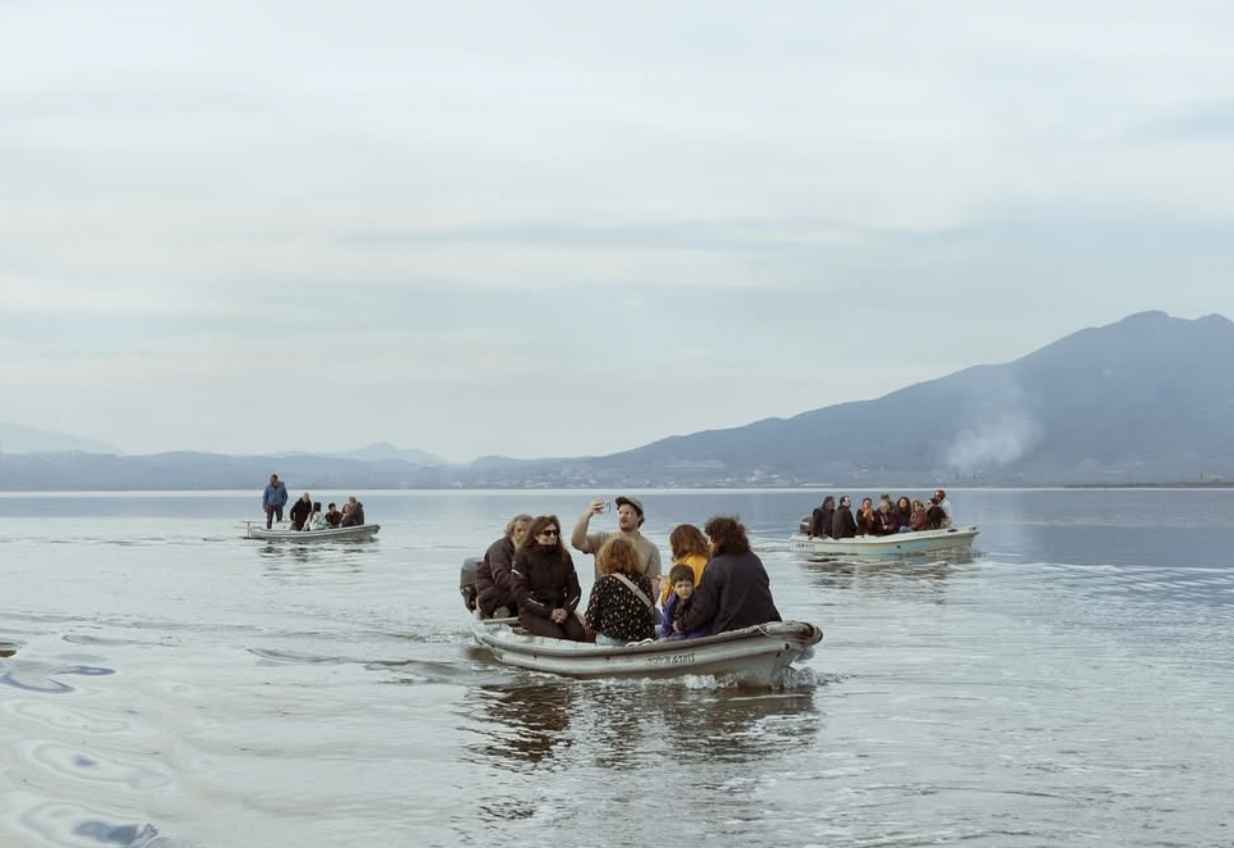
Maria-Thalia Carras: Absolutely. Many residents participated, especially on the Sunday, along with people from nearby villages. They repeatedly told us, “We are starved for culture.” In Greece, since nearly half the population lives in Athens, most of the cultural funding and activity is concentrated there. Many other regions are culturally neglected. The hunger for meaningful artistic engagement was palpable.
Nathalie Blanc: What’s next for you as a curator? Do you plan to stay in Tavros and build on what you’ve developed there, or move on to new territories?
Maria-Thalia Carras: I don’t know what the future holds — I don’t read horoscopes! But Tavros is a key focus for me because it represents an effort to build a mid-scale, independent institution — something sorely lacking in Greece. Most cultural institutions here are tied to the state or large private foundations, often with political or ideological agendas.
I believe we need professional, independent structures that aren’t beholden to systems of patronage. This is vital for democracy and plurality. So Tavros remains important, but I’m also open to working elsewhere, building new connections and dialogues across places.
Nathalie Blanc: Have you received invitations to intervene in other places as a result of Aitoliko?
Maria-Thalia Carras: Yes, we’ve had follow-up requests — including from Aitoliko itself. One of the small funders of the project now wants to organise the first Greek climate assembly there, based on the relationships and trust we built with local communities over two years.
We’ve also had interest from other regions. One in northern Greece, for example, is facing the destruction of a pristine landscape due to a hydroelectric plant. They approached us to explore how a cultural intervention could create space for dialogue.
Our work in Aitoliko is now considered a case study — possibly the first of its kind in Greece — for how art can engage with landscape through trust, scale, and sustainability. The project left no physical trace: all materials were sourced locally and returned afterward. What remained was a relationship — and a sense of mutual trust.
In a country so driven by tourism and extractive models of development, culture could offer an alternative way to generate value and foster more respectful forms of engagement with place.
Nathalie Blanc: Thank you very much.
¹ Locus athens is a nomadic non-profit arts organization, founded in 2004 with the aim of exploring the juncture between public space in Athens and contemporary art.
² It’s an event organised in the Transformative Territories project where the town of Aitoliko that became a living canvas for the Vanishing Landscapes gathering, a four-day event that wove together artistic expression, ecological reflection, and local histories. Bringing together artists, researchers, students, and community members, the programme delved into the layered narratives of this unique lagoon ecosystem.